|
Main Contents Page
About Information Literacy
STEP 1: STARTING out
STEP 2: FINDING
Information finding tools:
- Catalogue
- DDC (Dewey) system
- The Internet
- Databases (incl CD Rom)
Searching techniques:
- Boolean Logic
- Truncation/wildcards
- Phrase searching
Information sources:
- Dictionaries
- Encyclopaedias
- Atlases
- Books
Structure
Checklist
E-books
- Periodicals/Journals
- Newspapers
- Audio-visual
- Internet
- Broadcast media
- Grey literature
- Conference proceedings
- Maps
- Government publications
- Standards
- Museums
- Archives
- Theses and dissertations
- Quiz
STEP 3: EVALUATE
STEP 4: Legal & ethical USE
STEP 5: COMMUNICATE
|
 |
Structure of a book
It is important to understand the structure of a book. The main sections
of a book are:
-
The cover, which can be a hardcover or a paperback.
-
If it is a hardcover book it may have a dust jacket that
wraps around the book.
-
The next important part is the title page. It is a page on
the right side of the book that gives the title, the sub-title, the
author(s), and the publisher. Often the place of publication and the
date of publication is also given on the title page.
-
The imprint page (back of the title page) is also important.
Details about the book which are not given on the title page, as well
as other information, can be found on the back of the title page
Title page |
Imprint page |
The
Small Business
Action Kit
for South Africa
ARTHUR G
CLARKE
Francolin Publishers
Cape Town |
Published
by Francolin Publishers
1 Kendal Mews, Corner Main & Kendal Roads, Diep River, 7800, Cape
Town.
Copyright: Kogan Page Ltd 1994
South African adaptation Arthur G Clarke 1997.
All rights reserved, including the right of reproduction in whole
or in part in any form without the written permission of the publisher.
Editor - Louise Gain
Printing and binding - National Book Printers
|
-
The next important part is the contents page. The table of
contents gives an overview of how the subject of the book is being
presented - what sections are being dealt with and what the major
subsections are. This can be a good indication of the usefulness of
the book to the reader. The contents page is in the same order as
the text of the book and gives the page reference where a section
starts.
-
However, the index of the book (which is at the back of the
book) must be consulted. The book may contain information that the
reader will find useful and this may only be revealed by the index.
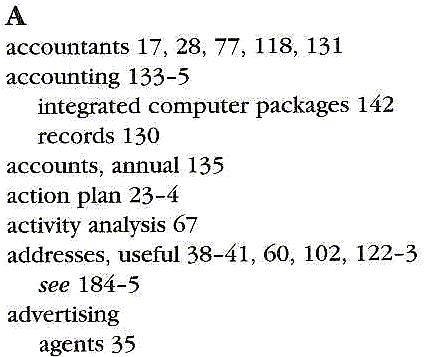
The index is an alphabetical list of topics and sub-topics
in the book. It also refers the reader to the page, see the following
example of an index.
|
|
|
|