CPUT Logo
Defining Keywords:

Broader and narrower terms


Main Contents Page

About Information Literacy

STEP 1: STARTING out

- Your information need

- Think about your need

- Read about your topic

- Defining keywords

Draw mind map

Broader & narrower terms

Other spellings

Examples per faculty:

Business

Mind map

Engineering

Mind map

Health & Wellness

Mind map

Applied Sciences

Mind map

Education & Social

Mind map

Informatics & Design

Mind map

- Cost of information

- Summary

- Quiz

STEP 2: FINDING

STEP 3: EVALUATE

STEP 4: Legal & ethical USE

STEP 5: COMMUNICATE


Arrow

Is there a broader or narrower subject that might include your topic, question or problem? Remember our topic is "Aids in the workplace."

t.gif t.gif t.gif t.gif t.gif
  A broader subject might cover things like:   A narrower subject might be:  
t.gif t.gif t.gif t.gif t.gif
 
  • immunological deficiency syndromes
  • Virus-induced immunosuppression
  • HIV infections
  • infectious diseases
 
  • AIDS
  • work safety
  • cost of AIDS in the workplace
  • prevalence of AIDS in the workplace
 
t.gif t.gif t.gif t.gif t.gif

You must identify as many as possible such broader and narrower terms. They will help you when you do your search. Using different words will retrieve different information, therefore use all possible options when you search for information.

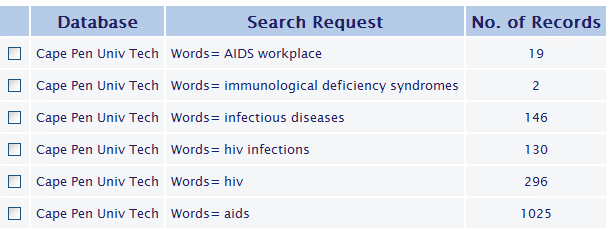
After searches were done on the Library on-line catalogue on some of the words identified above, the following was found:

t t t t
t Definition: t t
t Library online catalogue t t
t The Library on-line catalogue is a database of titles of all the books, journals and audio- visual resources available in the Library. t t
t t t t

Screenprint

It is clear that you get different results (varying number of "hits") from different words used in the searches. That is why it is so important to identify and follow up every possible word related to your topic.

Remember to keep any printouts of your searches, make notes of the resources found and keep information for your bibliographic records already at this early stage. See reading and making notes in step 5 to help you with this.